
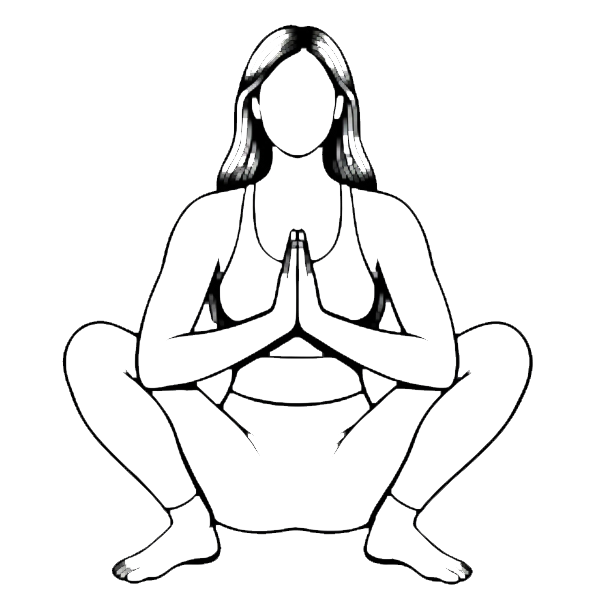
Malasana
Pose family
Deep Squat / Hip & Ankle Mobility
Body focus
Hips; ankles; adductors; gluteals; quadriceps; feet; pelvic control
The Story
The Old Seat
Long before chairs became the default, the deep squat was simply one of the ways human beings got close to the ground. Work could happen there. Food could be prepared there. A conversation could happen there. Malasana brings that ordinary human shape back into the yoga room and suddenly makes it feel exotic. For some bodies it is effortless; for others the heels hover, the ankles resist, or the hips run out of room. That difference is not a moral verdict on flexibility. Bone structure, limb proportions, strength, and mobility all influence the shape. Garland Pose becomes useful when it stops being a test and becomes an investigation: How wide do your feet need to be? How much turnout gives the knees room? What support lets the spine rise? Find the squat that belongs to your body.
The Body
Malasana combines deep hip and knee flexion with substantial ankle dorsiflexion. The hips are abducted and externally rotated enough to create space for the torso between the thighs, while the knees track in the same general direction as the toes. Quadriceps, gluteals, adductors, foot muscles, and trunk stabilizers all contribute to controlling the position. Individual anatomy strongly affects depth: ankle range, femur and tibia proportions, hip-socket orientation, and soft-tissue mobility can all change the appearance of the squat. Heels do not need to reach the floor; a folded blanket or wedge under the heels is a useful modification. Prioritize a stable foot, comfortable knees, and a spine that can lengthen.
Instructor Anatomy
Primary muscles
Quadriceps; gluteus maximus; adductors; soleus; intrinsic foot muscles
Stabilizers / secondary
Gluteus medius; deep hip rotators; transverse abdominis; spinal extensors
Joint actions
Deep hip and knee flexion; hip abduction/external rotation; ankle dorsiflexion; upright spinal extension
Anatomy cue
Let knees track with toes
Instructor Notes
Knees follow toes; Adjust stance to the body; Support heels if needed; Lift chest without forcing depth