
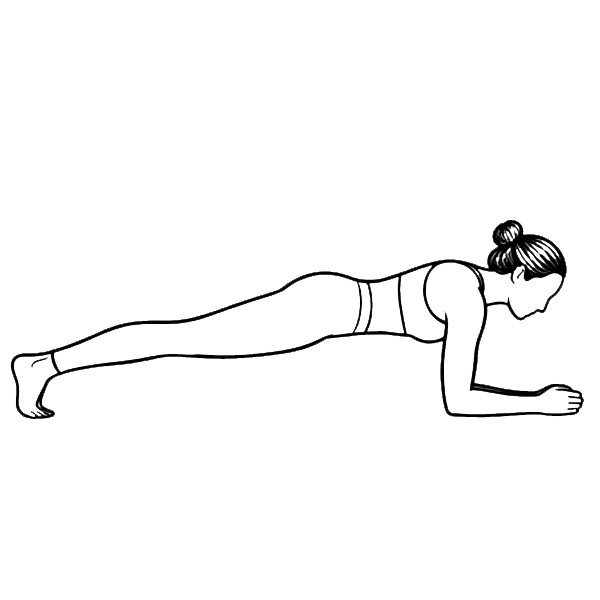
Makara Adho Mukha Svanasana
Pose family
Forearm Plank / Core Strength
Body focus
Abdominals; shoulders; serratus anterior; gluteals; quadriceps; full-body anti-extension
The Story
The Long Waterline
Dolphin Plank takes the high hips of Dolphin and lowers them until the body becomes one long line. The change looks small; the demand changes completely. Now gravity has more leverage against the center, and every part of the body has to contribute to keeping the line intact. Imagine a swimmer just under the surface: head, ribs, pelvis, and heels traveling in the same direction without one section sinking away from the others. The pose rewards distribution. Press through the forearms, reach back through the heels, and let the abdominal wall hold the middle without freezing the breath. Nothing needs to be dramatic. The work comes from staying coherent.
The Body
Dolphin Plank, or Forearm Plank, is an anti-extension trunk exercise performed with the forearms and toes as the base. The abdominal wall, including transverse abdominis, obliques, and rectus abdominis, works with the spinal stabilizers and gluteals to prevent lumbar sagging. Serratus anterior and the shoulder complex stabilize the scapulae while the deltoids and rotator cuff manage load through the upper body. Quadriceps maintain knee extension and the heels reach back to distribute the line of force through the legs. Keep shoulders approximately over the elbows, the back of the neck long, and ribs and pelvis traveling together. Lowering the knees is an effective way to reduce load without losing the essential pattern.
Instructor Anatomy
Primary muscles
Transverse abdominis; rectus abdominis; obliques; serratus anterior; deltoids
Stabilizers / secondary
Rotator cuff; multifidus; gluteus maximus; quadriceps; spinal extensors
Joint actions
Shoulder flexion; elbow flexion held isometrically; scapular stabilization/protraction; trunk anti-extension; hip and knee extension
Anatomy cue
Ribs and pelvis move together
Instructor Notes
Shoulders over elbows; Ribs and pelvis together; Reach heels back; Knees down to reduce load