
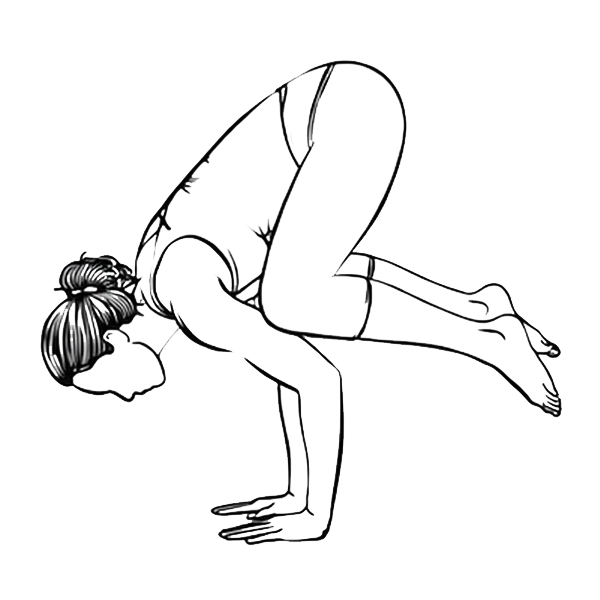
Kakasana
Pose family
Arm Balance / Compact Core Strength
Body focus
Wrists; triceps; shoulders; serratus; core; hip flexors; balance
The Story
The Crow's Compact Intelligence
Kakasana takes its name from the crow. In contemporary practice, Crow is often confused with Crane, but the useful distinction is visible in the arms: Crow keeps the elbows bent and the body compact, while Crane reaches toward straighter arms and a higher shape. The crow image suits the posture. It is close to the ground, alert, economical, and ready to move. The pose asks for curiosity rather than brute force. Shift forward enough to let the feet become light, round the upper back, and keep looking ahead. Flight begins not by jumping upward but by reorganizing weight.
The Body
Crow is a hand balance with the wrists extended, elbows flexed, knees supported against the upper arms, and the spine rounded. Serratus anterior protracts and stabilizes the shoulder blades while the triceps and pectoral muscles control the bent-arm support. Rectus abdominis, transverse abdominis, and hip flexors draw the lower body toward the trunk. The forearm and intrinsic hand muscles distribute pressure through the palms and fingers. Keeping the gaze slightly forward helps prevent the center of mass from dropping backward. Unlike Crane, the bent elbows create a lower, more compact support structure.
Instructor Anatomy
Primary muscles
Serratus anterior; triceps; pectoralis major; rectus abdominis
Stabilizers / secondary
Rotator cuff; transverse abdominis; wrist/finger flexors and extensors; hip flexors
Joint actions
Wrist extension; elbow flexion; scapular protraction; spinal flexion; hip flexion
Anatomy cue
Round upper back; look forward
Physiology / nervous system
Hand balance increases upper-limb loading and requires continuous pressure adjustments through the fingers and palms.
Instructor Notes
Spread fingers; Round upper back; Look forward; Squeeze knees into upper arms