
Supta Nitambasana
Pose family
Supine / Side-Body Lengthening
Body focus
Side ribs; lats; obliques; waist; shoulders; outer hips; breath
The Story
The Quiet Crescent
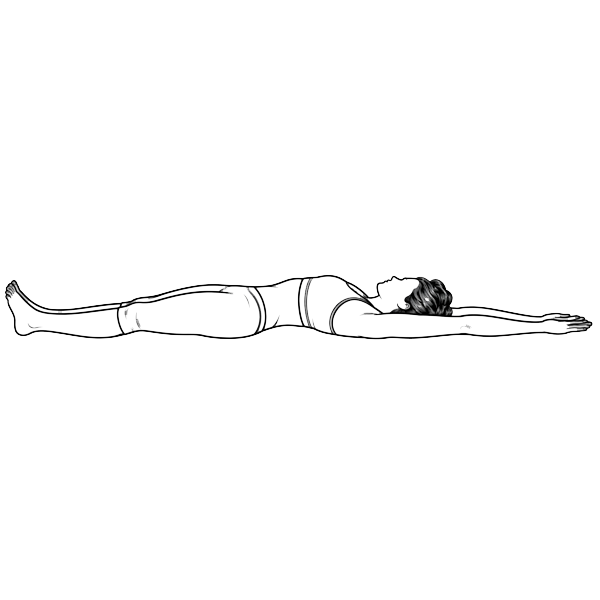
Banana is an informal modern name: when the supine body arcs gently to one side, its long outline resembles a crescent or banana. The Sanskrit label supplied for this reference, Supta Nitambasana, identifies a reclining shape associated with the hips. The PowerFlo illustration shows the long supine setup—back on the floor, legs extended, arms reaching overhead—from which the lateral curve can be introduced. The image is intentionally simple. The practice is not about forcing a dramatic bend; it is about creating length from heels to fingertips and then letting the side body open gradually while the back remains supported by the floor.
The Body
In the neutral setup, the shoulders flex overhead while the hips and knees remain extended, creating axial length through the whole body. In the common Banana variation, the legs and upper trunk shift to the same side to create gentle lateral flexion without rolling the pelvis or ribs into a twist. The latissimus dorsi, obliques, quadratus lumborum, intercostals, and tissues along the outer hip lengthen on the open side. The floor removes most balance demand, allowing the breath to expand into the side ribs. The shape should remain broad and easy rather than compressed through the low back or shoulder.
Instructor Anatomy
Primary muscles
Latissimus dorsi; obliques; quadratus lumborum; intercostals
Stabilizers / secondary
Deep abdominals; gluteus medius; rotator cuff
Joint actions
Shoulder flexion; hip and knee extension; gentle lateral spinal flexion in the full variation
Anatomy cue
Lengthen first; arc gently
Physiology / nervous system
The supported supine position can make side-rib expansion easier to feel while muscular effort remains low.
Instructor Notes
Stay on the back; Lengthen first; Arc gently; Keep ribs and hip points facing up